(n.) Cabindo: A condo on a lake, among tall old trees. Half cabin, half condo. My first home. This is a running journal of the renovations, projects, and general shoestring budget craziness.


- - - - - - - - - - - - - - - - - - - - - - - - - - - - - - - - - - - - - - - - -

Instagram

Tuesday, July 16, 2013

Articipation. Articipaaa-aaation.....

I make up words.

Articipation [ar-tis-uh-pey-shuhn]
noun
1.   the act of articipating.
2.   realization in advance of the awesomeness of art that is in transit.
3.   expectation or hope of beautiful walls.

My master bathroom has a lot going on: wainscotting with a shelf on top, bold flooring, bright colors, shelving, a huge mirror, yadda yadda yadda.


I've needed some art on the walls to compliment and calm the visual attractions going on elsewhere in the room. Because the wainscotting is up the traditional alley, I wanted something fun and modern to work with the colors of the room (teal, white, grey, black, silver), and balance everything out. The wall on which art should go is about 6 feet long and on your left when you walk into the room.

So I played with existing pieces I had, and nothing worked quite right. I sat and waited for the right thing to come into my life and get me excited.
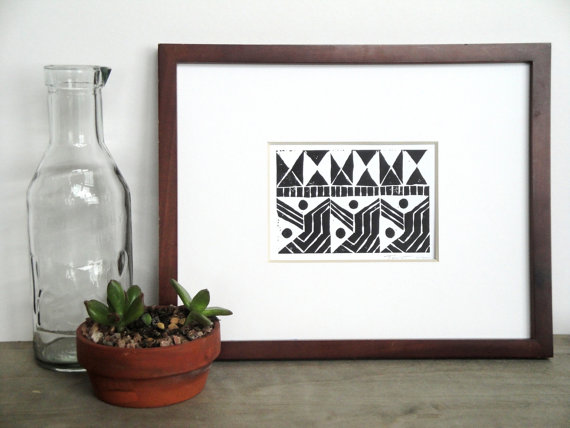
Enter HouseTweaking, a blog that I follow. Dana has a fantastic sense of style and utility as she manages three young kids and a total house renovation. She has been recently styling her nightstands and posted about some beautiful handmade block prints, which happened to be on a 50% off sale.

reminds me of indecipherable street signs in europe you look at and go:
'huh? balls bouncing down a hill next to a railroad crossing? TIMES THREE?!? oh dear....'

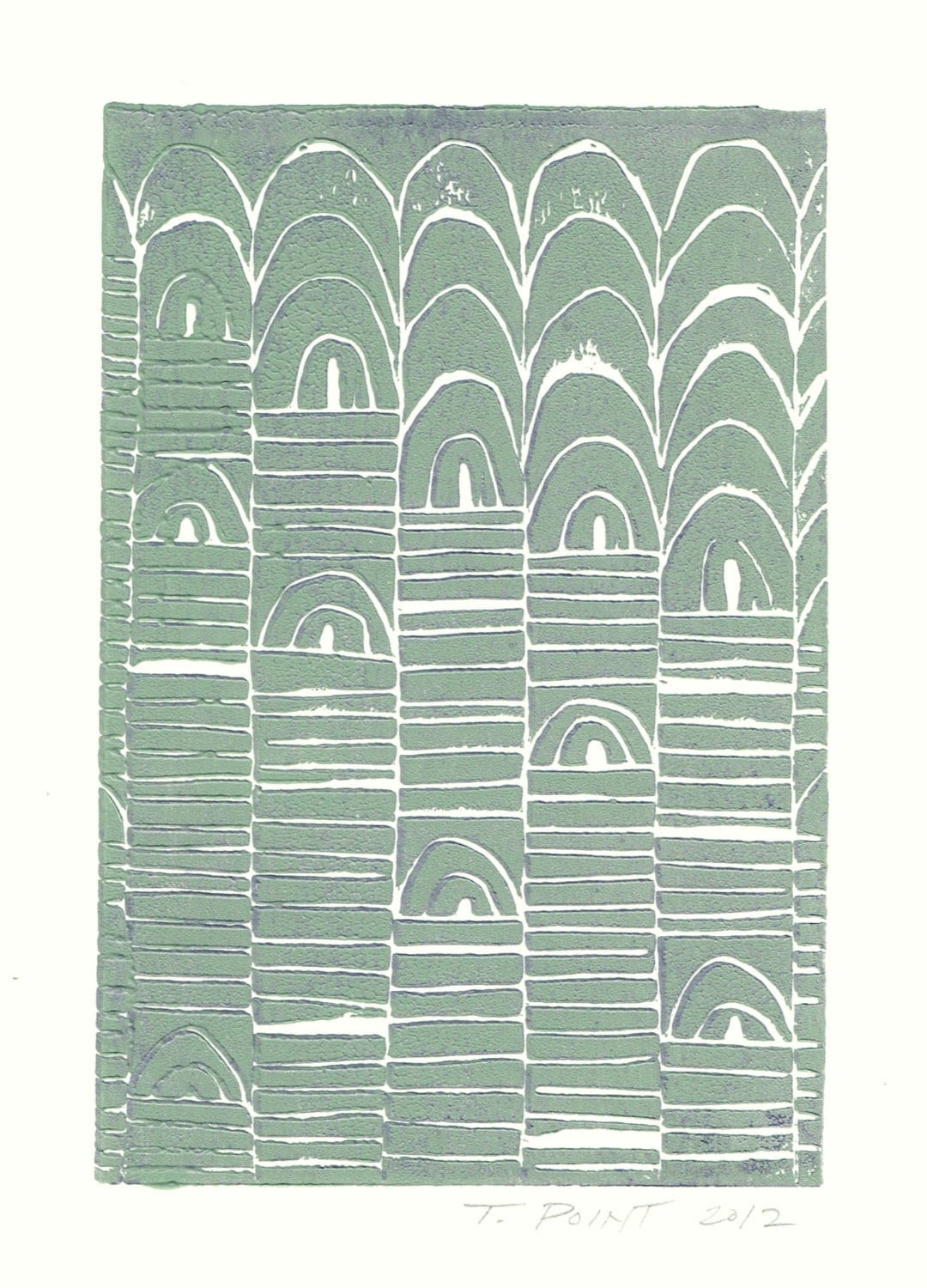
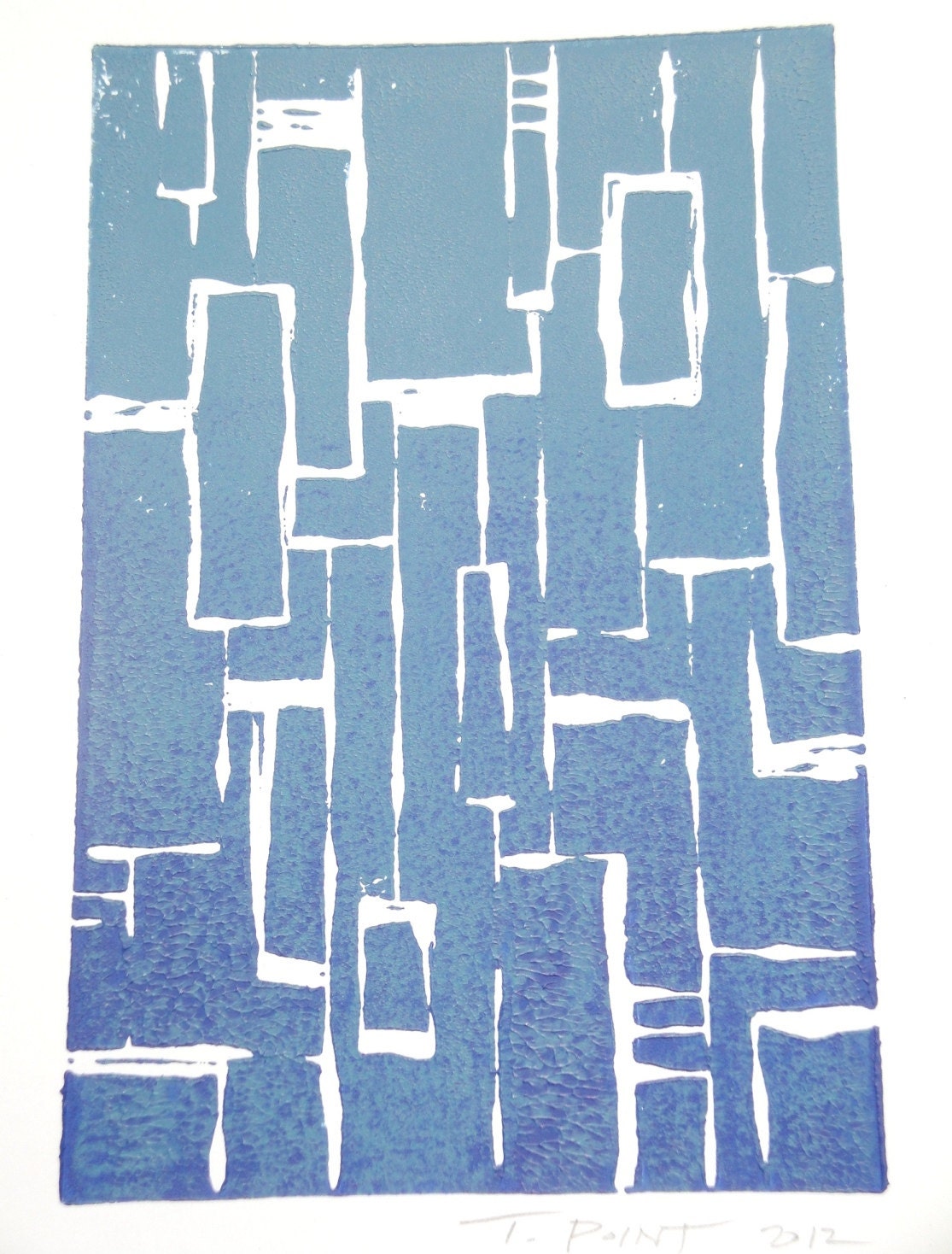
I'm not a huge abstract geometric fan, but I liked the impact they had in her space enough to go click through the etsy page. Therein I continued to not like them: I loved them. Many had blue/silver undertones that would both work well among several pieces, and compliment the color of the wall. Due to my art school days, I'm admittedly a bit of a snob: I don't buy reprints, only original medium work; so I cooed at the wood print-tastic depth of surface texture and dynamic sheen. There were lots of different patterns that suited my sensibilities and I could truly enjoy looking at every day, not just fake enjoy because they are hopelessly chic and I feel that I should. I struck while the 50% was hot and ordered the following prints:


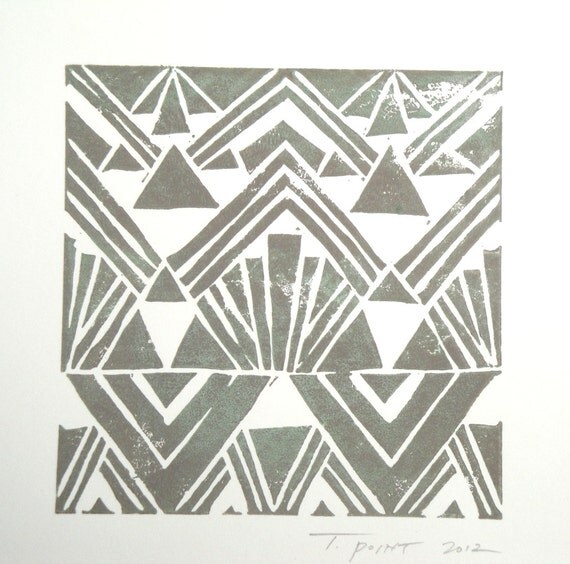
I thought they were a good combination of repetitive shapes, curves, lines, and colors; all in a semi-organic theme. Then I realised all but one was a 4x6, and that the single 5x7 would look out of place. I also thought some more neutral dark tones were needed, and quickly (truly, it was about 30 mins later) placed another order for some square black/grey prints:


That last one is more geometric that I thought I would go, but I like how art deco it looks.

I will be grabbing some Ribba frames in 4x6 and 5x7 sizes for $2 each.


I'm thinking high gloss grey as shown above would look fantastic, but I wont know for sure until I have those prints in hand.
This leads me back to the word of the day: articipation. I've been unreasonably excited for those prints to arrive. UPS tracking number stalking indicated this morning that they were out for delivery. Whoohoo!
Instead I went home to a notice that the prints are sitting and waiting at the post office. SO CLOSE.... yet so far. Protecting the contents, yeah yeah yeah, I get it. pffft.
In the meantime, I will just think about what a pretty wall it will be:

pinterest, of course.

and sing that dang song, substituting 'anticipation' with 'articipation'. #nerdalert.


-Lindsay


Friday, July 12, 2013

$2.50 Wooden Storage Bins

Things Organized Neatly is a blog that gives me goosebumps.
Because organization is a beautiful thing, and I'm horrible at it.
I have to create methods for organizing rather than claiming it as a quality that comes naturally. Organization works best for me when I can throw things into labeled containers rather then stack or arrange individual items. 


A similar lots-o-boxes solution was needed in my garage closet for all the tools strewn over each shelf.

before the tool takeover

Most attractive, durable, and non plastic bins start at about $12 a pop. Which as with everything else, is too rich for my blood.
Through my Pinteresting addiction, I'd seen a good tutorial for making cheap wooden bins here.


My boxes would need to be bigger to hold lots of tools, and lighter so I could easily lift them when full of said tools. Handles on both sides were also a must.

Using closet shelf measurements, I figured out how big I could make the boxes. They needed to be narrow enough to fit between the shelf brackets, and low enough to leave an inch or two of space open at the top for  I'm-feeling-too-lazy-to-even-pull-this-sucker-out tool deposits.
I made a cut list and headed to the hardware store. The boxes would need to be made of real wood, as MDF just doesn't last. I found the least expensive plywood I thought would stand up to the task: 1/4in. x 4ft x 8ft underlayment. With some quick math wizardry (for which I am widely NOT known), I figured out I could do all the boxes with just one $14 sheet in just a few cuts. A lovely staff member performed all the cuts I needed for the 45 sides and bottom pieces to make 9 boxes. I also grabbed some inexpensive 1x2's and got them cut to size for the corner pieces.

At home, I assembled the boxes the same way that Kristi did in her tutorial. I did use fewer screws because I didn't need to attach multiple separate boards on each side. And I was running out of screws that day.

sandpaper and sponge brushes, reporting for duty

I then sanded all the edges, as many of the plywood pieces had splintered veneers from being cut.
A little polycrylic sealed them up and brought out the grain of the wood.

For handles, I looked at the cheapest hardware store options and they were unattractive and would have almost doubled the per-unit cost of the boxes. Nahhhh. I could do better.
During my pallet excavating at the firehouse for the pallet table, I'd seen a big pile of old throw away fire hose. There are all sorts of things being made of of fire hose lately, why not handles?


So I got permission, took one, and cut it up while on duty into pieces about 1.5 x 6in.
I drilled two holes in each strip and two holes in the front and back panels of each box.  The distance between the holes in the strips were about 1.5 inches greater than that on the boxes, so when I lined the holes up and bolted the pieces together, the hose strip would buckle and have room for my hand.
I painted on chalkboard squares in roughly rectangular shapes on the prettier end of each box and set them to dry.

 Handles were cut from the side of the hose with the most writing

I split my tools up into 9 logical piles, used chalk to label each bin, and loaded em up.
I went with chalk rather than a permanent label because I already had chalk paint and chalk, and it made sense to use them since the content of the bins will change over the course of their lives.
The current bin types are: Adhesives, Paint, Hardware, Cutting/Sanding, Frequently Used Tools, Tools, Extra Tools, Housekeeping, Pets.

Into the closet they went, all pretty and ready to keep me organized.

life is like a box of hardware.....full of nuts

They are fantastic for pulling out and grabbing a tool, or picking up the whole box to take with me to a project location.
This (and only this) closet is now a highlight on the house tour when people come over.

Cost breakdown:
plywood - $14
corner wood -$5
chalkboard paint - already had it
fire hose - free
  nuts n bolts -$4  
$23

Price per bin = $2.50


-Lindsay

Wednesday, July 10, 2013

DIY Tub and Tile Reglazing

As I mentioned briefly in the Rehabbing a Bad Bathroom post; the tub surround in my master bathroom got redone, and there is a slightly bigger hole in the ozone. Both shall be explained here. Warning: this is a wordy post.

The Leadup ~
When I looked at the place, the master bathroom was boring, had an ugly floor, but gave an overall impression of being clean and functional. I even liked the simple white waffle-weave shower curtain.


I don't know why it did not occur to me to pull back that shower curtain and look at what was inside. I'd looked and formed opinions of the showers in every other property I went through. Seems I was blinded by love for the place and forgot all about bathroom due diligence.
Bad move kid.
During the home inspection, the inspector went to have a gander at the shower, but upon pulling back the curtain, we saw no shower stall; only ooold, crusty, sliding glass shower doors. Ok, not a big deal, I could easily rip them out and patch the holes with caulk.
When he opened the door, I was quite displeased to see brownish-green tile on the surround, with patches of white tile around the bottom.
What the what???
The white tile was clearly a replacement of some of the avocado tiles. The inspector didn't see any current issues; so whatever the problem was that necessitated the fix had been solved. Again, not a deal breaker, but the avacadosity was a much bigger issue and I was a bit grumbly at this point for the suprise, and that I hadn't seen it sooner.

A shot after the doors were removed.
Oh honey.....what did they do to you??

After removing the doors, there was adhesive left behind from the bottom track. It was applied in such a way that it had not sealed the connection between the track and the tub, so water leaking in over time had created mold, which in turn had eaten into the porcelain. Removing the mold and the adhesive left a very pitted strip all the way across the top of the tub wall. It is the grey line in the picture above.
The tiles were so ugly, I'd known that I wanted to reglaze them. With the exposed iron on the tub, I would need to reglaze the whole of that as well, since patching looks cruddy and is not durable.


Reglazing~

I had seen all sorts of information about getting a professional company to come and reglaze tile, but surprisingly found no home-blogger tutorials or walk throughs about doing it yourself with a kit.
While professional reglazing seemed to produce amazing results and garner tons of rave reviews, there was an equal amount of doom and gloom statements about how the diy kits are horrible to use, have immediately bad results, and fail quickly. I did not want to waste time or money on the kits only to run into trouble later, but neither was I going to be paying someone hundreds of dollars to do it, nor replacing the tub and tile.


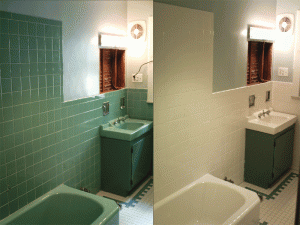
An example of professionally reglazed tub and tile.
The floor seems to have eluded capture.

So, I ended up doing a lot of research into why the professional method was so great, and why the diy method seemed to not work. The diy method seems to have the following critical failings:
1. Does not use etching chemicals, leading to bad glaze adhesion.
2. Hard to apply evenly, so produces a lumpy, uneven, dull, and unattractive surface.
3. Takes a long time to dry.
4. Harsh chemical smell.
5. Immediate or soon after scratching, chipping, or bubbling.

It seems that the lack of a porous surface for the diy kit's epoxy to mechanically bond with was the root of all evil.
I thought that I could overcome that big adhesion issue, work with the material's application limitations, minimize my contact with the fumes, and give it plenty of time to dry as I hadn't moved in yet. I bought 2 kits and dove in.

$37 at Home Depot

I read the instructions, and it seemed that the process was indeed insufficient to create a good surface for adhesion. It told users to prep the surface simply by using the provided degreasing wash and scrubbing with steel wool.
As with some other people who seemed to get good results (per the product reviews), I deviated from the directions for both surface prep and glazing.

I'll spoil the secret now: I got FANTASTIC results that have lasted for 8 months so far and show no signs of potential spontaneous failure. Listed below are the steps to get there.

Surface prep steps:
1. Scrub the heck out of the tub and tile with heavy duty household cleaner.
2. Remove all caulk. 
3. SAND the tub and tile with a mid level grit sandpaper. 
I used an orbital sander and 120 grit paper. You don't want to gouge the tile, just remove the shiny top glaze.
Use a particulate filtering mask, same as with any sanding project, to avoid inhaling the powdered glass.
4. Use the steel wool to scrub the surface with the provided cleaner product. 
I doubt this made much of a difference, but I did so for good measure anyway.
Be careful here, the caulk is gone so try and minimize the amount of wash seeping into any cracks.
5. Repeat steps 3 and 4, two times through. 
This wash n abrade cycle is actually on the instruction sheet. With sanding, this lets you gradually and evenly remove the shine from the tiles.
6. Wipe dry and let air out for a day or two. 
This lets any moisture that has gotten through caulkless seams dry out so you don't create a mold vault.
7. Tape edges and hardware.

Glaze prep steps:
1. Set the temperature to above 70.
This will help the glaze cure strong and be shiny.
2. Turn on the fan in the bathroom.
3. Put on some teeny and/or lightweight clothing.
Even with the fan on, it's gonna get hot in there with the door closed.
4. Mask up.
Get a mask that protects you from vapors/fumes. This will generally be a N95 or R95 rated mask. The epoxy is seriously not good for your lungs, and though masks are not the most stylish or comfortable things to wear: cancer is clearly less fun. Suck it up, it wont cost you much and you'll probably wear it again for another project. Or be someone from The Hot Zone for halloween. Or both. 
5. Put on a pair of goggles. 
Again, this is a big boy epoxy and your eyes will not like it. Grab a pair from your swimming stuff. 
6. Take a picture of yourself. You are aquaman. Nice short shorts. 

Tile Glazing steps:
Note: For changing the color of tile, it is recommended you use the brush on type rather than the spray. You are not going to be able to fight the fact that you can't get a perfectly smooth finish without spraying. Work with the nature of the material, and your inevitably imperfect diy technique, to come up with an attractive result rather than trying to fight it.

1. Use a BRUSH to apply an initial THIN layer of glaze to the tiles.
Ignore the instructions that say roller for this part.
2. Start in a top corner of the tile surround and brush in the same diagonal direction for all strokes.
This is part of the working with the material ramble above. Rollers are for flat and even results, which just aint gonna happen, so why set up the project for failure? Textured tiles exist in the world, so it was not a stretch to make these patterned, thereby also giving myself a lot of wiggle room for lumps and mistakes.

Here you can see the brushing texture and level of coverage on the first coat.

3. Go horizontally across each section then top to bottom.
This worked well for me and helped me keep a consistent and blended brush stroke.


Wrapping up the 1st layer.

After you have finished the surround, move onto the tub.

Tub Glazing steps:
1. Use a roller to apply an initial REALLY THIN layer of glaze.
While there is such a thing as textured tile, there are no textured tubs. Also, the tile is at eye level whereas the tub is at your feet. Any imperfections here due to the roller will be less noticeable.
The glaze seems to work and dry better on vertical surfaces than horizontal. When horizontal layers are applied too thick, it does not dry well. I know this because I did have issues in some spots where I'd caked it on and had to fix later. Not a problem with the product, just my application.
2. Start at a back corner and slowly work your roller back and forth longways in sections around the tub.
Do whole sections at once to minimize ridges: all of the wall-adjoining rim, all of the far side wall, front wall, back wall, etc.
3. Roll longways across all tub surfaces to tie in sections.
Work quick, this can't be done if it has already gotten tacky.
4. Don't forget the front of the tub.

Drying:
1. Give it 3 days to dry.
The directions tell you to redo it in a couple hours, or a couple days. This stuff is notoriously slow to dry, which happens when multiple layers are applied too soon, and it becomes a molten wrinkly nightmare. Have patience and give each layer a good long time to dry before slopping on the next one.
2. Leave temperature set, bathroom fan on, and door closed. Turn on the house fan.
If it's possible, stay out of the house for those three days, as the smell will waft even with the door closed. If this isn't an option, make sure to keep some windows open and the house fan on.

After 1 layer.
Already a huge difference!

After the first layer, you will see the spots of the old tile color showing through, grout lines that need more glaze, etc. Thats fine, leave it be. Once it's dry, you've got two more layers to go which will even everything out.
The picture above does not show the imperfections well, but you can see them in the close-up shots.

An additional two layers resulted in this:

oooooh...aaaahhhh

The directions will tell you to give the last layer extra time to dry. Do it. Double it. Triple it. Then add a couple extra days. You don't have to have the fans on, the heat cranked, or the door closed, but do not use the shower. This looong final drying time is another key step in making sure it is durable.

When I finished, the ugly paint on the wall was looking uglier compared to the shiny new white tiles, so I primed and painted a quick coat of tiffany blue on it. The wall color was later tweaked and more green added, but I digress.
The effect that the glazing had on the room, helped by updated paint, was tremendous.

Before & After

As I mentioned above: the results were great. I have not had any bubbling, cracking, or peeling. I did have some molten wrinkly issues on several horizontal spots in the tub where I'd put on layers too thick. That took several months to dry completely, at which time I sanded the wrinkles away and applied a thin layer to just those problem areas. That was my bad, not the kit, so overall I'd say from what I've seen so far, using the at home kit is a good money saving bet if you go above and beyond the directions a little bit.


-Lindsay


Monday, July 8, 2013

Creating custom adjustable shelving, ala the Container Store

Aside from painting top to bottom, built-in closet shelving was the first homeowner improvement project I tackled. I was giddy, I was broke, but I had a plan.

I may have mentioned it before, but my place is the condo-o-storage. It has more useful and plentiful storage than any ~1000 condo I've ever seen. Clearly, it was meant to be mine.
There are a remarkable FOUR hallway closets; a pantry, a linen closet, a coat closet, and a big empty space closet with a single upper shelf.
With a myriad of tools and materials for all my renovation projects, and no garage; I had to come up with a better storage solution than tossing everything in the big-empty-space closet.
I dreamed of Container Store Elfa shelving with vertical silver tracks and wooden shelves.

same size and # of shelves as I needed in the closet

Only $745 installed or $565 'DIY'........
Oh please to the %*#$ no.

I had a pile of fantastic old pine boards salvaged several years ago from a house I'd rented that was being torn down. They were the standard closet upper shelves, already finished in a pretty amber color.

comme ça

Using them for the shelves' surface was the linchpin in making this project possible, as I couldn't afford to buy all new hardwood boards, and saggy MDF was not gonna happen.
The hallway closet door doesn't run the full width of the closet, so I planned for 2 deep shelves on the bottom and 3 shallower ones above to get as much surface space as possible while allowing easy access to all shelves.

There were several different shelving systems at  my local Home Depot.
Pricey name brand ClosetMaid? Um, no thanks sister, I'll keep the $150 you would have cost and keep lookin.
Rubbermaid was the champ at $8 an upright, $3.75 for long brackets, and $3 for short ones.

upright
bracket


This broke out to:
$8 x 2 uprights =$16
$3.75 x 2 pairs of brackets = $15
$3 x 3 pairs of brackets = $18
    $4 x 1 box of anchors and screws = $4    
$53

Since $53 is about 9% of the high end $565 price tag: I was a proud, proud, thrifty gal.

Handy Dad and I ripped out the single upper shelf already in the closet to install the new tracks. The two holes we accidentally punched in the wall were just a bonus.
We hung the tracks starting about 6 inches down from the ceiling and ending about 8 inches up from the ground. This covered all the areas where I'd possibly want to have brackets for a shelf.
We then used the ripped out shelf as a guide to cut the pine boards to size. Something we learned here, that we keep re-learning; is that in a 40 year old building: nothing is square. Start with a pattern and then adjust for each instance of that item. That being said, unsuprisingly some shelves came out with a little wiggle room and others had to be trimmed down to fit. Between the track and the pine boards, we used scrap wood from Handy Dad's impressive garage collection to fill out the depth each shelf needed.
Each bracket has a hole for a screw, but I have neither done anything with that nor noticed the need to since construction.

hello there Garage Closet!

Not the prettiest girl at the dance, but heck, she's gonna be a glorified tool box. No worries princess.

Having gotten the hang of it, we went ahead and knocked out another set in the 2nd bedroom closet. There were two identical closets in there, each with a top shelf and hanging bar. Shelving was badly needed in one of them for office/sporting/random items, as all that hanging space would be wasted.


The wall came out unscathed on this one, but still no beauty queen in sight with those two franken-shelves on the bottom. Again though, its a closet. No one but the 5 people that read this blog (hi honey!) will see it; and inexpensive/functional/awesome always beats accumulating more debt. The mortgage alone is plenty!


-Lindsay


Saturday, July 6, 2013

Letting Go of Good Stuff

I have too many ideas and too much stuff to fit in my home.

In my dreaming and object hunting, I acquire really neat stuff for which I have grand plans. Somewhat regularly, I will realize that I'm never going to get around to executing my plan for an item, or it clearly just isn't working in the space. In an attempt to give as good as I get, not be a hoarder, and not create more trash, I take several avenues to move items along the furniture/home goods continuum.

wine rack and console table both interesting, both re-homed

1. I'll generally offer things to friends that seem applicable to their lives, ex. a guy on my team at work was moving to a new place and needed a dining room table: boom! He now has a newly refinished dining set for the low low price of 'Please take it! I'll help you move the thing'.
2. If I don't know of any specific person to attempt to force an item upon, and don't think I could reasonably sell it, I'll post it on Facebook to see if any friends could use it. This is a new strategy that seems to be working, but I'm going to try and keep it to a minimum to not carpet bomb people.
3. When I think the money I could get would outweigh the hassle of selling an item (anything less than $25 I'll just give away), I will post it on Craigslist for sale. This recently got me a cool $100 for an antique teacher's desk that cost $20.

Before, from PublicSurplus. Covered in tape with broken drawers.
After, with some love, fixes, and refinishing

4. When I have something that someone could want, but is odd, piddly or I want gone asap, I'll Curb Alert it on Craigslist.
Today on my way out the door I unloaded a tub overflowing with huuuge (1x3's) wooden blocks, took a picture, and posted em. I had an art project in mind when I bought these for $5.....but when I picked them they were twice as big and twice as many as I was prepared for. I kept a couple pieces to use for scrap wood, but the rest had to go.

I really should have built a tower out of them on the sidewalk.  Damn.

I don't want to just take take take. I feel like finding new homes for things I can't use helps me maintain some level of good-deal karma. There has been quite a purge of items around here lately, so hopefully I'm paying it forward for future deals.
:)


-Lindsay

Friday, July 5, 2013

Dishwashaaa

In a previous posting, I talked about my kitchen and the 'antique' appliances it came with, and how I'd replaced the stove. The second item on the hit list was the dishwasher.  Here is the story of how it's replacement came to be.


Since my new stove was nice and shiny stainless, I set out to find a new (to me) stainless dishwasher. I know dishwashers are among the cheaper appliances to buy new, but I'd been seeing a bunch of good looking ones being sold on Public Surplus. Turns out there's some mandate that all dishwashers in schools now have to be commercial grade, so they are dumping late model, perfectly fine non-commercial machines.
Through a serious commitment to lunchtime auction stalking, I saw one for sale in my area that looked promisingly modern. Sure it was white, but I could use a little paint to deal with that.
The bidding was fast and furious. Ha, just kidding. There was one other person who seemed interested, and only $10 of interested. The final price of the dishwasher after taxes, buyer premiums, and bid price was ONLY $11.86!!!! I was flabbergasted and cautiously optimistic that it actually worked, seeing as it was listed as condition 'unknown'.


A friend of mine lives out by the school district the dishwasher was from, and as is my normal food-for-help exchange scenario, she agreed to help me pickup the thing and then we'd go have lunch. I'd bought a small desk from the same school district and planned on stuffing both items into in the back of my Subaru Outback. Since a bigger item like the stove had already fit no problem, I had an over inflated sense of confidence about what could be hauled. The guys at the loading thought I was nuts, but both the machine and the not-so-small-after-all desk fit perfectly with the back seats down. I drove home nose to steering wheel and managed to lug the thing up the stairs by myself.

Plumbing is something I know nothing about and as there are immediate, serious, and super bad consequences for doing it wrong: I figured a professional installation would be worth every penny. Luckily, my Bf's parents gave me a very generous housewarming gift which covered all those pennies.


I've since painted the dishwasher to match the stove. I used appliance enamel on the top and bottom, which my girl Mary in the paint department was able to color black.
On the front panel, I applied two coats of aluminum paint to ensure good coverage. When they were dry, I painted on a third coat that I let dry halfway and then dragged a stiff brush through horizontally. This gave the panel a brushed look which made it look closer to real than just flat painting. I then over-fiddled around and it turned a bit splotchy. I need to learn when enough is enough. Perhaps in another 30 years. It will be an easy fix with another brush-dragged layer at some point, but at the moment, the general appearance of the kitchen is much improved.

Old and New
i take pictures like an off kilter drunk apparently
sorry

Stainless tile backslash post later. :)


-Lindsay

Wednesday, July 3, 2013

Rehabilitating a Criminally Bad Bathroom

The master bathroom has been the most extensive, time consuming, costly (though still on the cheap), and dramatic transformation of any room in my place. This is because it was clearly the only room in which there had been NO updates for many, many years. I did it all myself, with guidance and help from Handy Dad. In the process, traffic laws were broken and there may be a slightly bigger hole in the ozone, but none's perfect, and now the room's days of criminal ugliness are over.

I'll go into details in several future posts, but here's a quick before and after.

Before
this photo does it too much justice

List of offenses:
Crusty old shower head.
Splotchy black painted builder grade vanity. 
Both gold, silver, and paint splattered hardware. 
Rusted fan cover. 
Outdated tiny mirror that angled at your waist.
No personality.

After
favorite room in the place

Rehabilitation:
Herringbone pattern large slate tile floorsPink and white heart tile with brown grout. 
Subtly textured creamy white tile surround. Avocado green tile tub surround. 
Glass surround gone n holes repairedHidden nasty glass sliding doors. 
Big modern shower head and hand held sprayer. Crusty old shower head. 
Painted properly vanity in semi-gloss black. Splotchy black painted builder grade vanity. 
Painted hardware silver throughout. Both gold, silver, and paint splattered hardware. 
Painted cover n bolts silver. Rusted fan cover. 
Added stainless steel hooks on walls and bar on vanity. No towel bars. 
Over sized modern silver framed mirror. Outdated tiny mirror that angled at your waist. 
Installed wainscoting and trim throughoutBroken and skanky base trim tile. 
Hello gorgeous room! No personality. 

side by side


I look at the 'before' picture and it feels like a room in someone else's home. I look at the 'after' and I feel thankful for neighbors patient enough to live through all the banging and power tools it took to get there.

There's more work to be done here, but I can live with probation for now.


-Lindsay